Massachusetts - Selecting the Right Payer, Program, and Service
For Massachusetts EVV compliance and successful claims matching, every visit must include the correct Payer, Program, and Service Code combination. While all three elements are important, the Program is often the most misunderstood. Using incorrect information when a visit is created can increase the need for manual visit edits, result in non-compliant visit records, and lead to claims matching errors.
Why Are Payer, Program, and Service Code Important?
The Payer, Program, and Service Code work together to identify:
-
Who authorized the service (Payer)
-
What program the client is enrolled in (Program)
-
What service was provided (Service Code)
All three elements must accurately reflect the client's authorization information.

Provider
The Provider represented on the visit is the organization that submits the claim to the Payer.
If you are a subcontracted agency that provides the service but invoices another provider, ASAP, or third-party organization for payment, your agency may not be the Provider that should be represented on the visit.
The Provider recorded on the visit should be the organization whose Medicaid Provider ID Service Location (PIDSL) appears on the claim submitted to the Payer.
Why This Matters
When a claim is submitted, the Provider's PIDSL is included on the claim and used during claims matching.
If the visit is not associated with the Provider account tied to that PIDSL, the claim may fail to match the visit.
Payer
The Payer on the visit is the entity contracted by the Commonwealth of Massachusetts to authorize the Medicaid-funded services being provided to the client.
For subcontracted arrangements:
-
The organization paying your invoice is not necessarily the Payer.
-
The Payer is the organization or health plan in which the client is enrolled and that authorizes the service.
Why This Matters
Many EVV systems associate clients with a payer record. In some subcontracting arrangements, providers may incorrectly associate a client with another provider or intermediary organization.
For EVV compliance, the Payer selected on the EVV visit should always be the organization that authorized the client's Medicaid-funded service.
A Program is the mechanism through which a client receives authorized home and community-based services.
Think of the relationship this way:
-
Payer = Who administers and authorizes services
-
Program = Which benefit, waiver, or service program the client is enrolled in
-
Service Code = The specific service delivered
The Payer evaluates the client's needs, enrolls them in an appropriate Program, and authorizes services under that Program.
Why Programs Cause Confusion
Many providers assume the Program is:
-
The client's Medicaid eligibility category
-
The payer name
-
The service being provided
In reality, a Program identifies the specific Medicaid-funded benefit, waiver, or care program under which services are authorized.
Learn How to Identify a Client's Program
The client's Program information comes directly from the Payer that authorized the service.
Providers can determine a client's Program by:
-
Reviewing the care plan or authorization provided by the Payer.
-
Checking payer-specific eligibility or authorization portals.
-
Contacting the Payer case manager.
-
The Eligibility Verification System (EVS) provides important benefit information about MassHealth members. Providers must check EVS before providing services to MassHealth members. Eligibility verifications through the POSC can be performed via Direct Data Entry (DDE) for a single member verification or via Batch for checking multiple member verifications at the same time. More information on submitting transactions through the POSC and via Batch via EDI is available on the Massachusetts website at: https://www.mass.gov/info-details/eligibility-verification-system-overview.
If you are unsure of the Program, the Payer is the authoritative source.
Massachusetts Program Codes:
| Program Name | Program Code on Visit |
|---|---|
| Choices/Waiver | CHOICES |
| Home Care Basic/Waiver | HCBW |
| ECOP/Non-Waiver | ECOP |
| Home Care/Percent Based | HCPB |
| Home Care Basic/Non-Waiver | HCBNW |
| ABI/MFP | ABI-MFP |
| Home Health | HH |
| Group Adult Foster Care | GAFC |
| Personal Care Attendant Program | PCA |
| Self-Directed Moving Forward Plan WAiver | SDMFP |
| Self-Directed ABI Plan Waiver | SDABI |
| SCO - Wellsense ASAP | SCBMC |
| SCO - Commonwealth Care Alliance ASAP | SCCCA |
| SCO - Fallon Navicare ASAP | SCFAL |
| SCO - Senior Whole Health ASAP | SCSWH |
| SCO - Tufts ASAP | SCTUF |
| SCO - United ASAP | SCUNI |
| SCO - Mass General Brigham ASAP | SCGBS |
Acronyms
-
ABI/MFP = Acquired Brain Injury / Moving Forward Plan
-
ECOP = Enhanced Community Options Program
-
SCO = Senior Care Options
-
ASAP = Aging Services Access Point
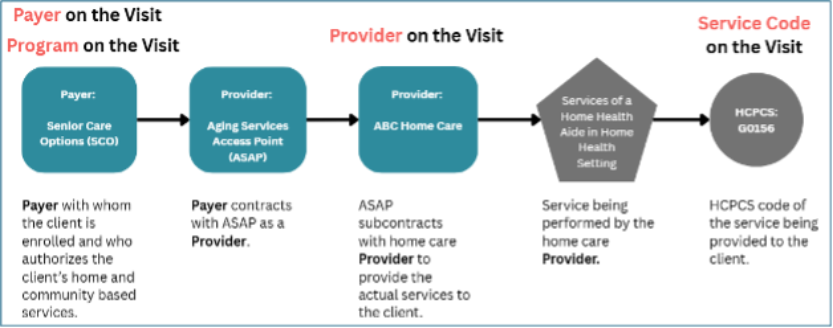
A common area of confusion occurs when:
-
A Senior Care Options (SCO) Plan authorizes services.
-
The SCO contracts with an ASAP.
-
The ASAP subcontracts with a home care or home health provider to deliver the service.
In these situations:
-
Payer on the Visit: SCO Plan
-
Program on the Visit: SCO Program Code
-
Service Code on the Visit: Actual service delivered to the client
The ASAP is not entered as the Program simply because it coordinated the service.
| Program Name | Program Code on Visit |
|---|---|
| SCO - Wellsense ASAP | SCBMC |
| SCO -Commonwealth Care Alliance ASAP | SCCCA |
| SCO - Fallon Navicare ASAP | SCFAL |
| SCO - Senior Whole Health ASAP | SCSWH |
| SCO - Tufts ASAP | SCTUF |
| SCO - United ASAP | SCUNI |
| SCO - Mass General Brigham ASAP | SCGBS |
-
Verify the client's Payer before creating visits.
-
Use the Program identified by the Payer's authorization or eligibility information.
-
Ensure the Service Code matches the authorized service being provided.
-
Do not assume the Program is the same as the Payer.
-
In subcontracting arrangements, identify the actual Payer and Program authorizing the service, not the organization receiving your invoice.
-
Review visit configuration regularly to reduce manual edits, avoid EVV compliance issues, and improve claims matching success.